
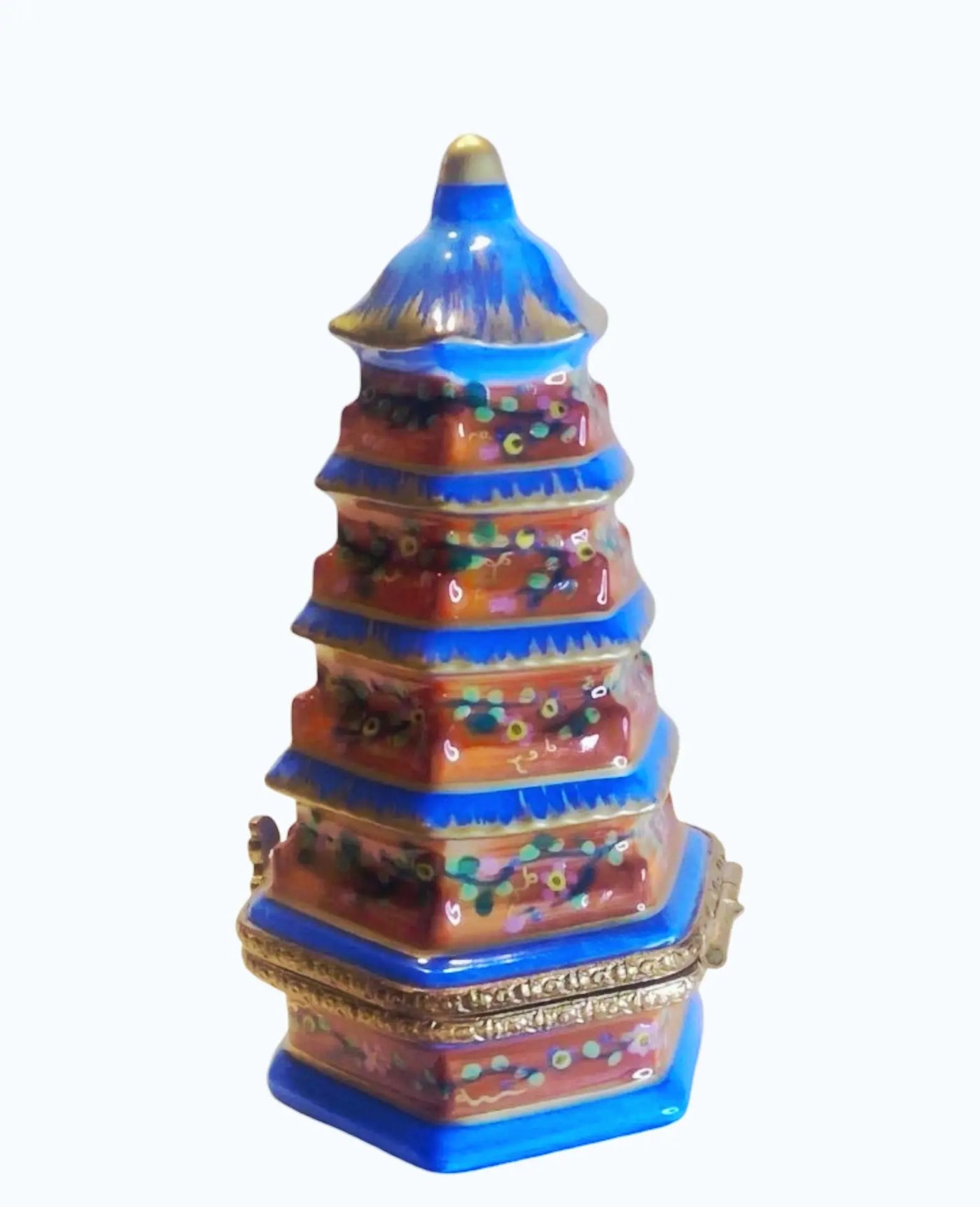
A Limoges box is made from hard-paste porcelain in the Limoges region of central France, then finished by hand: the white porcelain is cast in a mold, fired at very high heat, painted with enamel colors, fired again for each layer of color, and fitted with a hand-set brass hinge and clasp. One small box can pass through a dozen pairs of hands and several kiln firings before it is ready. Here is how that happens, step by step, and what to look for when you hold one.

What makes porcelain "Limoges" porcelain?
The story starts with kaolin, a fine white clay. In the late 1760s, rich kaolin deposits were found at Saint-Yrieix-la-Perche, near Limoges. That discovery let French workshops make true hard-paste porcelain, the same dense, bright white material that had been imported from China for centuries.
Hard-paste porcelain is a blend of kaolin, feldspar and quartz. Fired at very high temperature, it becomes glassy, strong and slightly translucent at its thinnest edges. Within a few decades, Limoges had become one of the great porcelain centers of Europe, and it still is today.
A short history: from snuff boxes to collectibles
Small hinged porcelain boxes were fashionable in 18th-century France for carrying snuff, patches, pills and sweets. Ladies and gentlemen kept them in a pocket or on a dressing table, and the finest ones were small works of art.
Over time the purpose changed, but the form stayed. Today a Limoges box is mostly a keepsake: a tiny sculpture that opens, made to celebrate a birthday, a wedding, a pet, a trip to Paris or a favorite hobby. The craft, though, is still done much the way it always was.
How a Limoges box is made, step by step
1. Designing and making the molds
Every shape begins as a model, often carved by hand. From that model, workers make plaster molds for the base and the lid. Because porcelain shrinks noticeably in the kiln, the molds are made larger than the finished box. Complex shapes, like an animal with a raised tail or a cake with layers, may need molds in several parts.
2. Casting the porcelain
Liquid porcelain, called slip, is poured into the plaster mold. The plaster draws water out of the slip, and a thin wall of porcelain forms against the inside of the mold. The extra slip is poured off, and the piece is left to firm up before it is gently removed.
3. Trimming and smoothing by hand
Fresh from the mold, the piece has seam lines and rough edges. A craftsperson trims the seams, smooths the surface with a damp sponge and checks that the lid and base will meet cleanly. This quiet step is one reason a good Limoges box feels so crisp in the hand.
4. The first firing and glazing
The pieces get a first, lower firing that hardens them enough to handle. They are then dipped in glaze, a thin coating that turns glossy and glass-like in the kiln.
5. The high firing
Next comes the main firing, at roughly 1,400°C (about 2,550°F). This is what turns clay into true hard-paste porcelain: dense, white and very hard. It is also where many pieces are lost, since any warp or crack shows up here. Only the white blanks that come out clean move on to painting.

6. Hand painting
Now the artist takes over. Using fine brushes and enamel colors made from metal oxides, the painter adds every detail: fur, flowers, lettering, a tiny Eiffel Tower, a gold rim. Many boxes are painted inside as well as out, so there is something lovely to find when you lift the lid.
Each color often needs its own trip to the kiln at a lower temperature, which fuses the paint into the glaze. A detailed box may be fired several times over. Because people paint them, no two boxes are exactly alike, and small differences are part of the charm.
7. Fitting the hinge and clasp
The last step is the metal work. A brass frame is fitted by hand to the rim of the base and lid, then joined with a small hinge. The clasp, called the fermoir, is often shaped to match the theme of the box: a tiny bow, a flower, a paw print or a bird. Fitting it so the lid closes snugly takes real skill.
8. The surprise inside
Many Limoges boxes hold a tiny porcelain charm inside, such as a mouse in a cheese box or a baby bottle in a stork box. It is one of the small delights that collectors love. You can also tuck in a small charm or note of your own before giving it.
Peint Main, Rehaussé Main and other marks
Turn a Limoges box over and you will usually find marks on the bottom. Here is what the most common ones mean:
- Limoges France: the porcelain was made in the Limoges region.
- Peint Main: French for "hand painted." The decoration was painted by hand.
- Rehaussé Main: "hand enhanced." Part of the design is a printed transfer, with details added by hand.
- Artist initials or a maker's mark: many boxes carry the painter's initials or the workshop's mark.
For photos and a fuller explanation, read Limoges Box Marks: How to Identify an Authentic Limoges Box.

How to tell if a Limoges box is real
Beyond the marks, your eyes and fingers can tell you a lot:
- Look at the painting up close. Hand painting shows brush strokes and slight variation. A flat, dotted print pattern suggests a cheaper transfer.
- Check the metal work. The hinge should be straight and the clasp should close with a gentle, secure click.
- Feel the weight and finish. Hard-paste porcelain is dense and smooth, with a clear glassy glaze.
- Hold it to the light. Thin edges of fine porcelain often show a soft glow.
Every box we sell is authentic Limoges porcelain from France. If you are curious why prices vary so much between boxes, our page on Limoges box prices explains what goes into the cost.
Why the handwork matters
Molds, kilns, painters and metal fitters: each stage adds time and skill, and each is a chance for a piece to be set aside if it is not right. That is why a genuine Limoges box feels different from a mass-made trinket box. It is a small object with a lot of care in it, and it can be passed down for generations.
To see the range of shapes this craft produces, start with our classic Limoges boxes, or look for designs that are no longer made in our retired and rare Limoges boxes. A few favorites that show off fine painting and metal work are the Colorful Pagoda Box, the Venice Woman in Masquerade and the Basset Hound Beagle on Stones.
Caring for a hand-painted Limoges box
- Dust with a dry, soft cloth or a soft brush.
- Never put a Limoges box in the dishwasher or soak it in water. Water can loosen the metal mounts.
- Pick it up by the base, not the lid, so you don't strain the hinge.
- Open and close the clasp gently.
- Display it on a shelf or in a cabinet away from the edge, where it will not be knocked.
More tips are in our guide to caring for and displaying Limoges boxes.

Frequently asked questions
Are Limoges boxes still made in France today?
Yes. Workshops in the Limoges region still cast, fire, paint and mount Limoges boxes using the traditional steps described above.
How long does it take to make one Limoges box?
It varies with the design. Between casting, drying, several firings, painting and fitting the metal work, a single box takes many days to move from raw porcelain to finished piece, and detailed designs take longer.
What is the hinge on a Limoges box made of?
Most hinges and clasps are brass, sometimes finished in gold tone or antiqued. The decorative clasp is called the fermoir.
Why do two of the same Limoges box look slightly different?
Because each one is painted by hand. Small differences in color or brushwork are normal and show that a real person did the work.
What does "Peint Main" mean on the bottom of a box?
It is French for "hand painted." Look for it alongside "Limoges France" on authentic hand-painted boxes.
Ready to find one of your own? Browse all our authentic Limoges boxes, hand-painted in France. Questions? Call (855) 606-5288 or email support@limogesbox.com.

